
When chimney work in San Francisco needs a permit
Most routine chimney repointing in San Francisco does not need a permit. Structural or framing-connected work usually does. Here is where the line sits.
Published
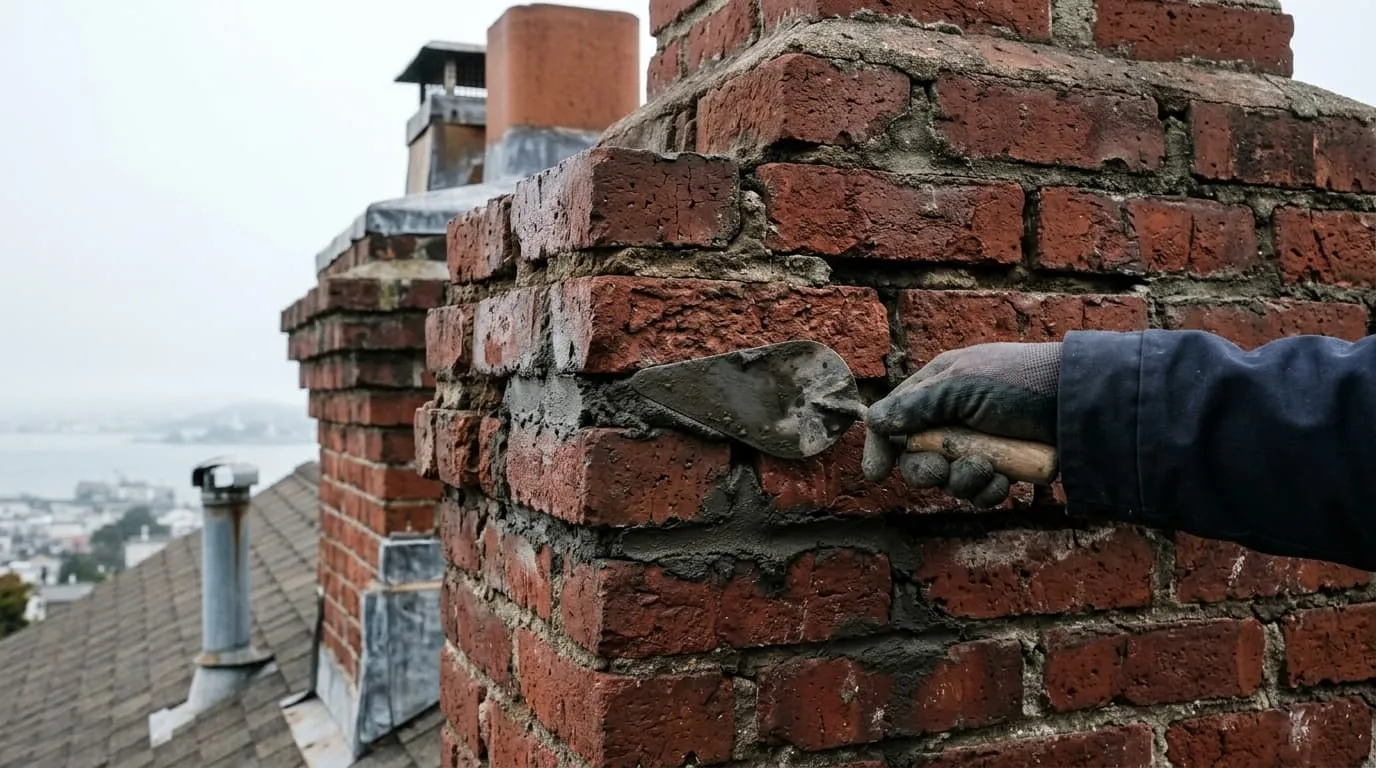
San Francisco’s Department of Building Inspection does not require a permit for straightforward repointing, but the line moves fast once a repair touches structural framing or seismic bracing. Here is what actually triggers one.
Permit questions come up on almost every San Francisco repair job sooner or later, usually somewhere between “how bad is this crack” and “how long will the work take.” The honest, if slightly unsatisfying, answer is that it depends on what the work actually touches. The San Francisco Department of Building Inspection, known locally as SFDBI, draws that line in a fairly specific place.
The baseline: routine repointing generally does not need one
Straightforward mortar repointing (repairing the joints between existing bricks without changing the chimney’s structure, height, or how it connects to the house) generally does not require a building permit in San Francisco. This is true regardless of the chimney’s age: repointing a century-old Victorian stack in Noe Valley and repointing a considerably newer chimney elsewhere in the city fall under the same non-permit category, as long as the work is genuinely limited to restoring existing mortar joints rather than altering the structure itself.
Where the line actually moves
The permit requirement changes the moment work touches the chimney’s structural connection to the building, its seismic bracing, or anything affecting the building’s envelope more broadly. Rebuilding a chimney from the roofline up, adding or modifying structural ties between the chimney and the house framing, or any work that changes the chimney’s height, footprint or basic structural configuration typically crosses into permit territory, and this applies regardless of the building’s age or the cost of the job. A relatively small-sounding repair, like reinforcing a structural tie on an older masonry chimney, can require a permit even when a considerably larger-sounding repointing job does not, because the deciding factor is what the work actually does structurally, not how big it sounds from the outside.
Why this trips people up
Most homeowners reasonably assume that permit requirements scale directly with the visible size or cost of a job: a bigger repair means a permit, a smaller one does not. San Francisco’s actual rule does not work that way. It is entirely possible for a modest-looking crack repair to need a permit because it touches a structural connection, while a considerably more visible, labor-intensive full repointing of an entire chimney face needs none at all, because it never alters the underlying structure. Knowing which category a given repair actually falls into, before work starts and not after an inspector asks about it, is part of what a proper diagnostic scope is for.
What happens if a permit is skipped when one was needed
Beyond the straightforward risk of a stop-work order or a fine if the work is discovered during an unrelated inspection, unpermitted structural work can create real problems down the line: most commonly at the point of a future home sale, when a buyer’s inspection or a title search turns up work that does not match city records. For San Francisco’s real-estate market specifically, where a pending sale is one of the more common reasons a chimney gets a close inspection in the first place, an unpermitted structural repair discovered mid-transaction can complicate or delay a closing in a way that is considerably more disruptive than simply pulling the permit would have been at the time of the work.
Historic districts add a second layer to check
A number of San Francisco neighborhoods, including sections of the Mission, Noe Valley and Pacific Heights, sit within locally designated historic districts or contain individually landmarked buildings, and exterior masonry work on a building in either category can trigger an additional review beyond SFDBI’s standard structural threshold, specifically aimed at preserving the building’s historic appearance rather than its structural safety. This review most commonly comes into play for anything visible from the street, such as a chimney’s exterior brick face or its crown profile, even when the underlying repair itself would not otherwise need a structural permit. Confirming a property’s historic-district status before starting exterior masonry work avoids a surprise partway through a job that otherwise looked routine.
How this interacts with older, unreinforced masonry
A meaningful share of San Francisco’s chimney stock predates any seismic bracing requirement, and repair work that specifically addresses that gap (adding a proper structural tie to an older masonry chimney that never had one) is exactly the kind of work that typically needs a permit, precisely because it is altering the structural relationship between the chimney and the building. This is worth knowing going in: a repair aimed at improving an older chimney’s seismic safety is often, correctly, treated as more significant by the permitting process than a purely cosmetic repointing job would be, even though the seismic work is arguably the more important of the two for the building’s actual safety.
What we do before any permit-adjacent work starts
Because the permit line depends on the specific scope of the work rather than its apparent size, we identify upfront whether a given repair is likely to require SFDBI sign-off, and we say so plainly as part of the written scope, before any work begins and not partway through. For anything that does need a permit, that process adds time to the schedule that a purely cosmetic repointing job would not need, and we account for that honestly when discussing timeline rather than treating it as a surprise partway through the job.
Read next
More from the blog
Get a written scope
A full inspection first, then a written account of exactly what the work involves: no verbal estimate from the driveway.