Chimney repair · San Francisco

Chimney repair in San Francisco

Worried a small crack means a much bigger, more expensive job than it actually is.

No obligation. Call and we’ll confirm when we can come by.

  • Every repair is scoped in writing after a real inspection, never estimated from the driveway.
  • Work ranges from a single-day repointing job to a multi-day crown or liner project.
  • No prices are quoted publicly — every scope reflects the actual condition found.
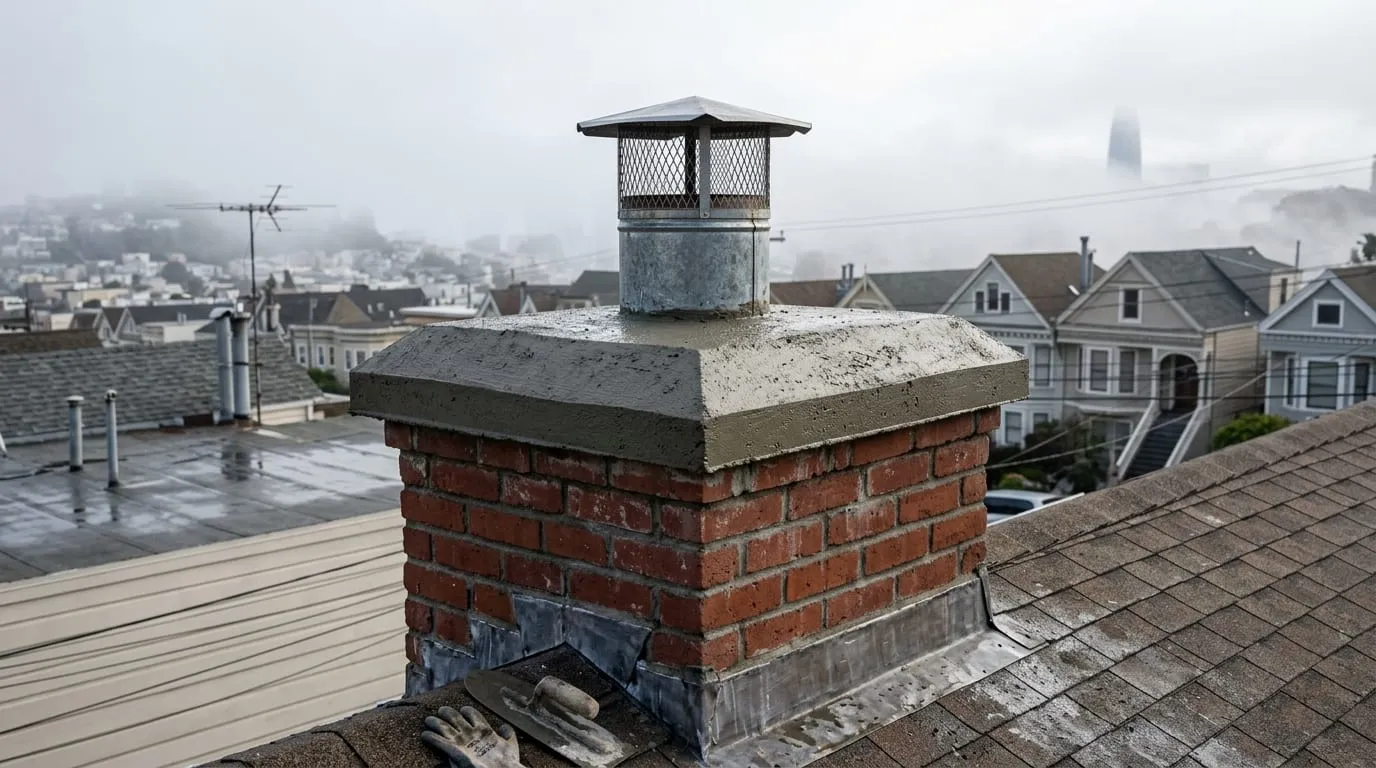
A freshly poured concrete chimney crown with a sloped surface and a drip edge, seen from a San Francisco rooftop with fog in the background

What repair covers

Where water and stress actually travel

Crown, mortar, flashing and liner, in the order a real problem actually moves through them — traced against the same cutaway every service on this site uses.

The short answer

Chimney repair covers everything from a small mortar repointing job to a full crown rebuild or liner replacement, and the honest answer to how big a given repair is depends entirely on what an inspection actually finds — never on the age of the house alone. In San Francisco, two things drive repair calls more than anywhere else in our service area: persistent coastal fog and marine-layer moisture working into a cracked crown even on days with no measurable rainfall, and a genuine share of Victorian and Edwardian-era brick chimneys old enough to predate any seismic bracing requirement. We diagnose before we quote, scope the work in writing, and never treat a hairline crack as an excuse to sell a full rebuild it does not need — or downplay a structural-tie problem a repointing job alone will not fix.

Cutaway of a masonry chimney: the cap and spark arrestor at the top, then the crown, the flue liner running down inside the brickwork, the mortar joints, the flashing where the stack meets the roof, the smoke chamber, and the firebox down at the hearth.01020304050607
  1. 01Cap and spark arrestor Keeps fog drip, eucalyptus debris and nesting birds out of the flue. California’s fire code sets the minimum mesh spacing for the spark-arrestor screen.
  2. 02Crown The sloped slab across the top. Coastal fog settles on it for hours at a time even on a rainless day, and that standing moisture is what opens the first crack.
  3. 03Flue liner The passage the smoke leaves by. A break in it is a safety fault, not a maintenance item.
  4. 04Mortar joints In an unreinforced pre-1940s stack this is also where a shaking chimney tends to shear first — a fact tied directly to the Bay Area’s earthquake risk, not just to age.
  5. 05Flashing The seam between stack and roof. On an older Bay Area home this seam has usually been re-tarred more than once, and a bad reseal is a common source of a slow ceiling stain.
  6. 06Smoke chamber The shelf a flue brush never reaches. When a house smells of last winter, this is usually where it is coming from.
  7. 07Firebox The only part of the whole system most people ever see — and the last place a problem turns up.

Book this if you noticed

The usual signs

  • A visible crack across the crown, or discoloration on the brick just below it.
  • Mortar joints that look chalky, crumbling, or are visibly missing in spots.
  • A water stain on the ceiling or wall near the chimney after fog or rain.
  • A chimney that leans, or shows a new gap where it meets the roofline.

Not sure it needs repair? Call (628) 245-1261 and describe it — we will point you to the right service.

What is included

Repair, scoped plainly

Included

  • A full diagnostic inspection before any repair is scoped
  • A written scope naming exactly what needs doing
  • Repointing, crown, flashing or liner work as the diagnosis actually calls for
  • A structural-tie check on any pre-1940s masonry chimney

Not included

  • A full chimney rebuild from the roofline down, quoted and scheduled as its own larger project if the damage genuinely calls for it
  • Structural engineering certification beyond the chimney itself, referred to a licensed engineer when a repair touches the building’s framing

A full rebuild is its own larger project, quoted separately, so a repointing job never turns into a surprise bill.

The visit

How a repair actually goes

  1. 1

    Full diagnostic inspection

    Crown, mortar, flashing and liner are checked in the order water and structural stress would actually travel — never just the symptom you called about.

  2. 2

    Written scope, before any work starts

    You get a plain description of what needs doing and why, with no verbal-only estimate from the driveway.

  3. 3

    The repair itself

    Repointing, crown rebuilding, flashing resealing or liner work, scheduled around what the property actually needs.

  4. 4

    Structural-tie check on older masonry

    On a pre-1940s chimney, we confirm how it is tied to the house framing as part of the same visit, not as a separate upsell.

  5. 5

    Final walkthrough

    We show you what was done and what to watch for, before we consider the job finished.

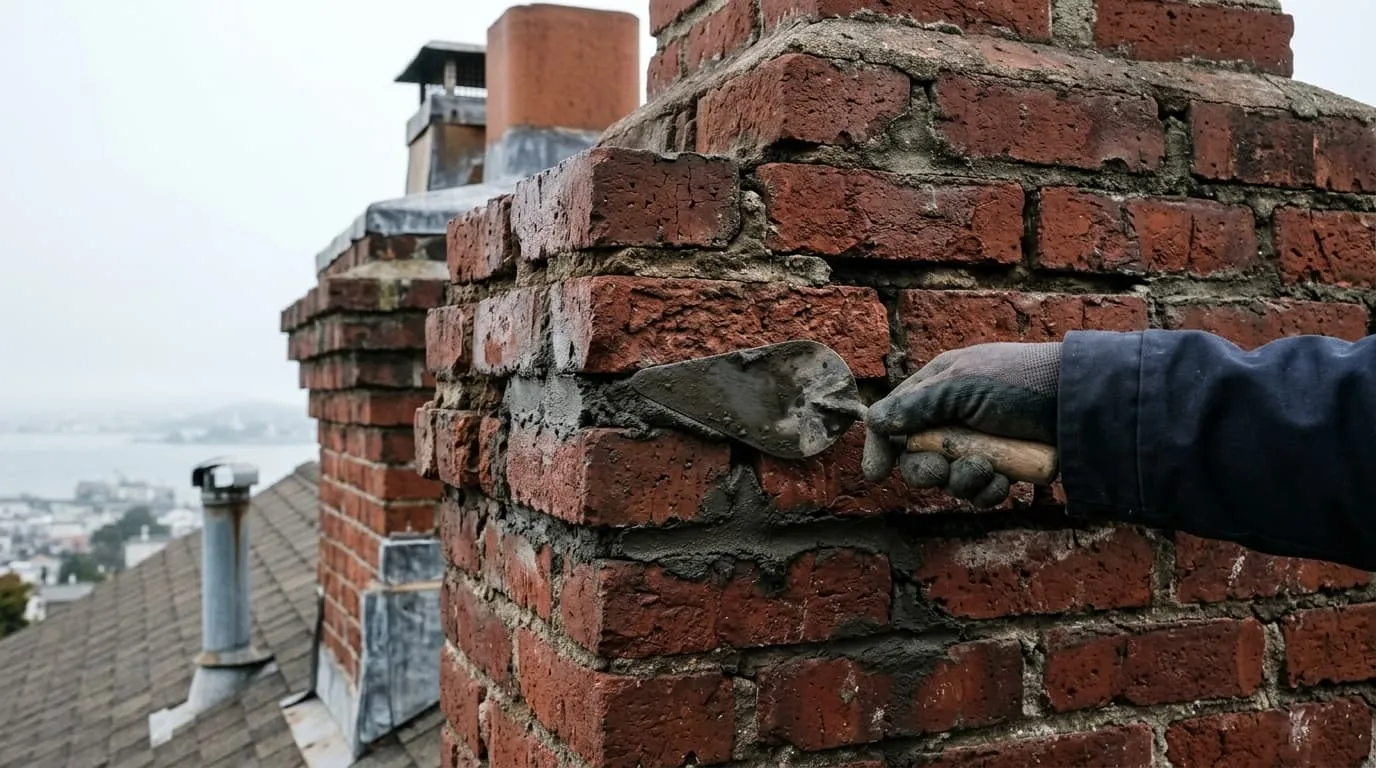
A mason repointing eroded mortar joints on a brick chimney of a San Francisco Victorian home

Repair specifications

Repair, by the numbers

The figures a repair scope is measured against — condition-based, never age-based alone.

Crown
Sloped, cracked-free, thrown clear of the brick
Mortar joints
Full, unweathered, no visible gaps
Flue liner
Continuous, no cracks or missing sections
Structural ties
Checked on any pre-1940s masonry chimney
Flashing
Fully lapped and sealed at the roofline

NFPA 211 condition criteria; San Francisco Department of Building Inspection permit thresholds for structural work.

In detail

Why fog and older masonry both drive repair calls here

How persistent marine-layer moisture and pre-1940s brick construction change what a San Francisco repair actually involves.

01Repair is a diagnosis first, a job second

The single most common mistake in chimney repair is treating the visible symptom as the whole problem.

Continue reading

A water stain on a ceiling near the chimney might be a failed crown, a flashing problem, deteriorated mortar, or some combination of all three — and treating only the symptom that happens to be visible from inside the house means the real cause keeps working on the masonry, unaddressed, until it shows up again. Every repair we do starts with a full diagnostic pass through the same sequence water and structural stress actually travel: the crown first, then the mortar joints, then the flashing, then the liner. What we find at each stage determines the scope — never the other way around.

02Why San Francisco’s fog is a repair driver, not just a climate note

Rainfall totals do not tell the real story of chimney moisture damage in San Francisco.

Continue reading

The city’s persistent coastal fog — especially thick and frequent across the western neighborhoods, but present to some degree across most of the twenty-mile service area — settles on an exposed chimney crown for hours at a stretch, on days when a weather report would show zero measurable precipitation. A crown that was poured flat instead of properly sloped, or one that has simply aged past its original seal, develops hairline cracks the same way it would anywhere, but the fog gives those cracks far more wet-hours per year to work with than a rainfall total alone would suggest. That is why a crown crack that might sit relatively stable for years in a drier inland city tends to progress faster here.

03The seismic question that rain alone never raises

A meaningful share of San Francisco’s older housing — the Victorian and Edwardian rowhouses across the Mission, Noe Valley, the Haight and beyond — carries brick chimneys built decades before any seismic bracing requirement existed.

Continue reading

That masonry can be structurally sound in the ordinary sense, holding up fine to weather and age, while still lacking a proper tie to the house’s framing that would keep it from shifting or shearing during significant ground motion. A repair visit on a pre-1940s masonry chimney includes checking that structural connection directly, not just the visible condition of the brick — a question a purely cosmetic repair would never think to ask.

04Matching the repair to the original construction

Repointing an older brick chimney is not simply a matter of packing new mortar into old joints.

Continue reading

Historic masonry, especially anything built before the mid-1900s, was typically laid with a softer, more porous lime-based mortar than what is standard today. Repointing with a modern, harder Portland-cement mortar against that older brick can actually accelerate damage — the harder mortar does not flex or breathe the way the original material did, and it can force moisture to escape through the brick itself instead of the joint, spalling the face of the brick over time. Matching the mortar type to the original construction is part of doing the repair correctly, not an aesthetic preference.

05What changes the scope, and what never does

A single repointing job on an accessible section of chimney is a modest, contained repair.

Continue reading

A full crown rebuild, a liner replacement running the full height of the flue, or work that requires addressing a structural-tie deficiency on an older chimney is a considerably larger undertaking — and the difference between the two is determined by what the diagnostic inspection actually finds, never assumed from the chimney’s age or the neighborhood it sits in. What never changes is the sequence: diagnose fully, scope in writing, then do the work — and we say so plainly if an inspection finds less wrong than a symptom suggested.

06Booking a repair in San Francisco and the Bay Area

If you have noticed a crack, a stain, mortar that looks worse than it used to, or simply want an older chimney’s structural condition confirmed, we start with a full inspection and a written scope before any work begins.

Continue reading

We work across a twenty-mile radius from central San Francisco.

Reviews

What the last 17 customers actually said

5.0

17 Google reviewscounted 2026-08-26

  • 517
  • 40
  • 30
  • 20
  • 10
  • Jennifer Garcia

    Heavy Stage 3 creosote had built up within an inadequately sized flue pipe, but a vigilant technician cleaned it away, preventing catastrophic fire dangers.
  • Miguel Reynolds

    Last winter we got a weird burning smell every time we used the fireplace. They cleaned a thick coating of soft creosote from the higher tiles and the stench is completely gone now.
  • Leonardo Madden

    Most sweepers only glance up with a flashlight. This team established a thorough monitor and pointed out minor gaps in the mortar parging, and brushed the smoke chamber till it appeared brand new.
  • Rhiannon Wimer

    Punctual, polite, and thoroughly professional. They treat your home with total respect and deliver world-class service every single time.

Read all 17 reviews on Google

Questions

What people ask about repair

Does a cracked crown always mean a full rebuild?

No — many cracked crowns are repaired by resealing or recoating the existing slab. A full rebuild is only what we recommend when the crown itself has failed structurally, and we explain the difference plainly before quoting either.

Why does San Francisco fog matter for chimney repair specifically?

Persistent marine-layer moisture settles on a crown and works into a crack even on days with no measurable rain, so a crack that might sit dormant longer in a drier climate tends to worsen faster here — which is part of why we check the crown closely on almost every San Francisco repair call.

Is my Victorian chimney’s mortar different from a modern chimney’s?

Often, yes — older lime-based mortar is softer and more porous than modern mortar, which affects how repointing should be done. Matching the original mortar type matters for both appearance and how well the repair actually holds.

Do you check for earthquake-related damage during a repair?

Yes — on any pre-1940s masonry chimney, we check the structural ties to the house framing as part of a repair visit, since that connection matters as much as the visible condition of the brick itself.

Will you tell me if a repair is not worth doing?

Yes — if an inspection finds a chimney is sound and a symptom turns out to be minor or cosmetic, we say so. A repair we did not need to sell you is not one we will invent a reason to sell.

Book a repair inspection

Describe what you have noticed — we will diagnose it and put the scope in writing before any work starts.

Or call (628) 245-1261 to book directly.

Tell us what changed.

Tell us what the fireplace is doing and what changed. Someone reads every message that comes in.

No obligation. Call and we’ll confirm when we can come by.

Prefer to talk? Call (628) 245-1261 — we’ll confirm when we can help.