Unreinforced masonry chimneys and San Francisco’s earthquake risk
A pre-1940s San Francisco brick chimney predates any seismic bracing code. Why that matters, and what the San Andreas and Hayward faults mean for it.
Published
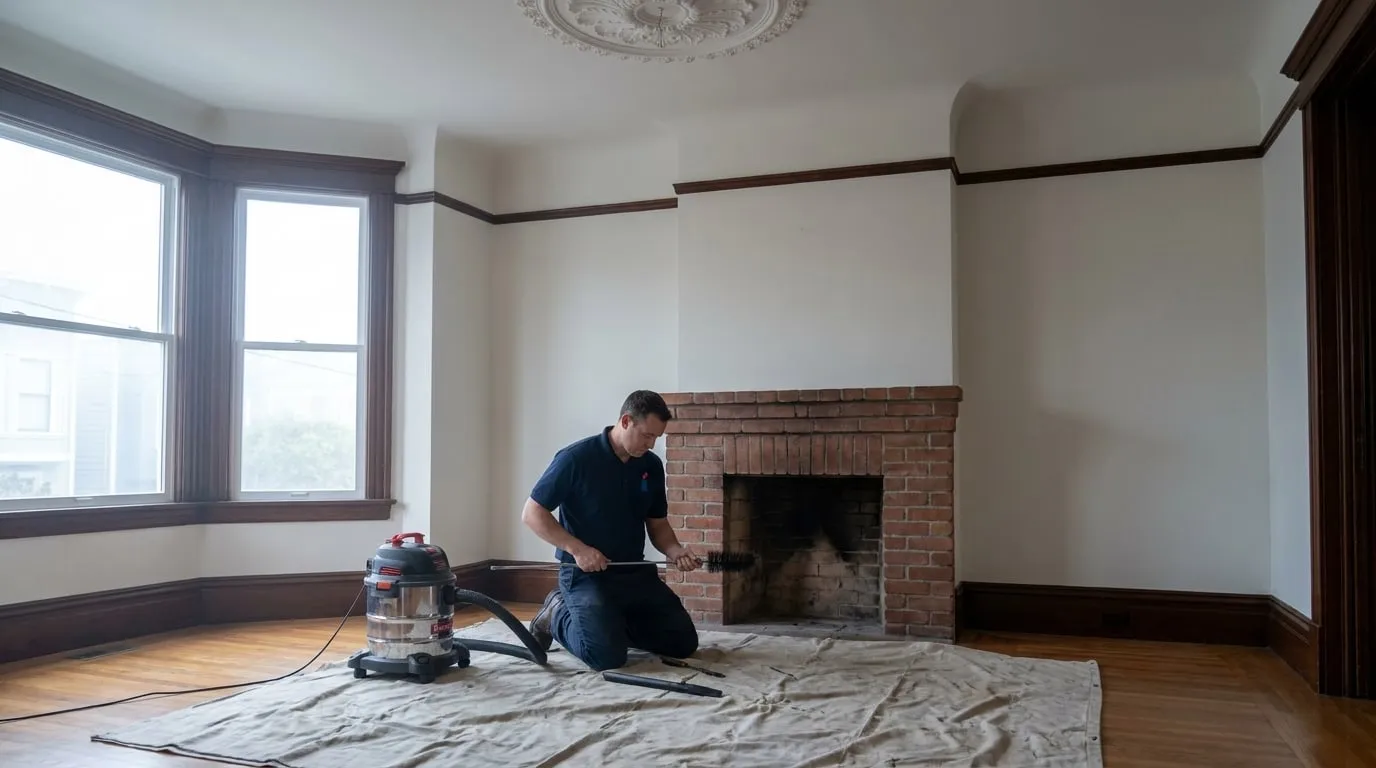
San Francisco’s Victorian and Edwardian brick chimneys were built before any seismic bracing requirement existed. Here is what that means structurally, what the region’s two major faults have to do with it, and what a real inspection looks for.
Walk down almost any block of Victorian or Edwardian rowhouses in the Mission, Noe Valley or the Haight, and there is a good chance a meaningful share of them still have their original brick chimney standing, a genuinely old piece of masonry construction built decades before anyone was thinking about seismic bracing as a building requirement. That age is not a decorative detail. It is a structural fact with real implications, and understanding what it actually means is worth doing before assuming an old chimney that “has always looked fine” will keep looking fine indefinitely.
What “unreinforced masonry” actually means
Unreinforced masonry, often abbreviated URM, describes a construction method where brick or stone is stacked and held together with mortar alone, with no steel reinforcement running through it to help the structure flex or hold together under lateral force. It was the standard way to build a chimney (and, for that matter, many larger buildings) for most of San Francisco’s early history, right through the building boom that followed the 1906 earthquake and fire. Modern building codes require steel reinforcement and specific bracing details precisely because unreinforced masonry has a well-documented, repeatedly observed failure pattern during significant ground shaking: it tends to crack along the mortar joints and, in more severe cases, can shear apart or topple entirely, disproportionately more than a reinforced structure built to withstand the same shaking.
Two faults, not one, shape the risk here
San Francisco sits close to the San Andreas Fault, which runs offshore and along the Peninsula just to the south and west of the city, and which produced the 1906 earthquake that leveled much of the city’s building stock and reshaped its rebuilding for the following two decades. The Bay Area’s other major fault, the Hayward Fault, runs through the East Bay hills (Berkeley, Oakland, Hayward, El Cerrito), well within our own twenty-mile service radius, and the U.S. Geological Survey rates it among the most likely faults in the country to produce a major, damaging rupture within the coming decades. A significant earthquake on either fault sends shaking across a wide swath of the region, which is why chimney condition after any regional seismic event is worth checking regardless of exactly where the epicenter happened to be.
What actually fails, and why it is often invisible from the ground
The failure point on an unreinforced masonry chimney during ground shaking is rarely the brick itself giving way outright: it is more often the mortar joints between bricks, and specifically the connection where the chimney ties, or fails to tie, into the surrounding house framing. A chimney that is not properly anchored to the structure around it can rock independently of the house during shaking, working the mortar loose at that connection point even when the visible brick above the roofline looks completely undisturbed afterward. That is precisely why a purely visual inspection from the ground, checking only for an obvious lean or a visible crack, can miss a genuine structural problem that a more thorough check would catch.
What NFPA 211 calls for after a seismic event
The industry’s own inspection standard, NFPA 211, is specific about this: after an event that may have compromised a chimney’s structural integrity (an earthquake being the clearest example), the appropriate response is a Level 3 inspection, the most thorough of the three levels the standard defines. A Level 3 can involve opening a portion of the chimney or an adjacent wall to examine a suspected problem directly, precisely because a Level 1 or even a camera-assisted Level 2 inspection may not reveal a structural-tie problem sitting outside the flue itself. Treating a post-earthquake chimney check as equivalent to a routine annual sweep-and-inspect visit is treating a structural question as a maintenance one.
What we actually check on older San Francisco masonry
On any pre-1940s brick chimney, a repair or inspection visit includes a direct look at how the structure is tied to the house framing, beyond the condition of the visible brick, mortar and crown. That means checking for signs of movement at the roofline connection, looking for cracking patterns consistent with rocking rather than simple weathering, and being straightforward about the difference between a chimney that needs ordinary maintenance and one that has a genuine structural-tie deficiency worth addressing directly, potentially with input from a structural engineer for anything beyond the chimney’s own scope.
This is not a reason to panic about every old chimney
None of this means every Victorian-era chimney in San Francisco is a hazard waiting to happen: the overwhelming majority have stood through more than a century of the region’s seismic activity without major incident, including the 1906 and 1989 Loma Prieta earthquakes. What it means is that age alone should never be the basis for assuming a chimney is fine, any more than age alone should be the basis for assuming it is dangerous. An actual inspection, done at the right NFPA level for the situation (routine, or after a real seismic event), is what actually answers the question, rather than either extreme assumption.
Read next
More from the blog
Get a written scope
A full inspection first, then a written account of exactly what the work involves: no verbal estimate from the driveway.