What San Francisco’s fog actually does to a chimney
San Francisco’s chimneys age on fog-hours, not rainfall. Here is the mechanism, which neighborhoods see it worst, and what stops it.
Published
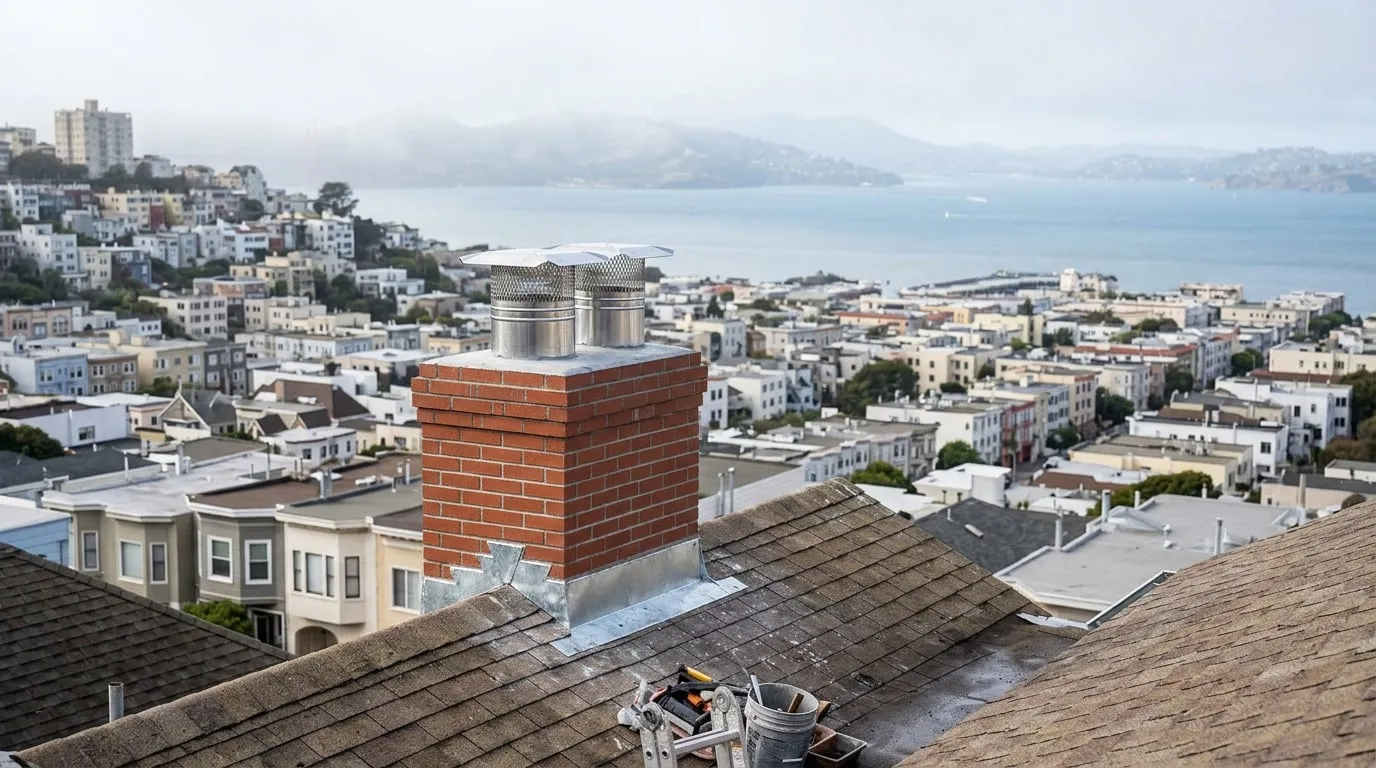
A San Francisco chimney can corrode and crack on a week with zero measurable rainfall, because the coastal fog rolling through the Golden Gate behaves nothing like a rainstorm. Here is why fog-hours matter more than rain totals, and where to look first.
Ask most people what damages an outdoor structure in a wet climate, and they picture rain: a downpour that soaks a surface, then a dry stretch that lets it recover. San Francisco’s chimneys do not get that dry stretch nearly as often as the city’s modest annual rainfall total would suggest, because the thing actually working on them most of the year is not rain at all. It is fog, and fog behaves in a way that is quietly harder on masonry and metal than an equivalent amount of rainfall would be.
What fog actually does that rain doesn’t
Coastal fog forms when warm air passing over cold Pacific water condenses, then gets pushed inland through gaps in the coastal hills, the Golden Gate itself being the most famous funnel of all. Once it arrives, it does not fall and drain the way rain does. It settles, clings, and sits directly on any exposed surface for hours at a stretch, sometimes overnight and well into the following morning before it burns off (if it burns off that day at all). A chimney crown under a fog bank can stay continuously wet for far longer, on far more days per year, than the city’s rainfall statistics alone would ever indicate. Some of San Francisco’s foggiest neighborhoods see measurable fog on well over half the days in a typical summer, a season the rest of the country associates with dry roofs, not wet ones.
Why that changes how a crack behaves
A chimney crown’s whole job is to shed water off the top of the stack and away from the brickwork underneath. A hairline crack in that crown is, at first, a cosmetic problem: small enough that it does not visibly leak, small enough to ignore. What it needs to become a real problem is repeated exposure to standing moisture, because water sitting in a crack does two damaging things: it seeps slowly into the masonry core below, and during any cold snap, it can freeze and expand, widening the crack a fraction more each cycle. In a genuinely dry climate, a crack like that might sit relatively stable for a long time, with only occasional rain events giving it anything to work with. Under San Francisco’s fog pattern, that same crack gets far more wet-hours per year to exploit, and the crack that would take years to become a real problem elsewhere can progress meaningfully faster here.
The fog belt, and what shelters the rest of the city
Fog exposure in San Francisco is not evenly distributed. The Sunset District, the outer Richmond, and much of the western half of the city sit directly in the path of fog pushing in off the ocean, and the difference is dramatic enough that it is a running local joke: “the fog belt” is a real, commonly used phrase for exactly this part of the city. Cross over Twin Peaks into the Mission, Noe Valley or Bernal Heights, and the same week can look and feel meaningfully sunnier and drier, sheltered by the hills from the direct fog flow. Two nearly identical Victorian-era chimneys, a few miles apart, can be aging on genuinely different timelines depending on which side of that line they sit on. It’s part of why we look at a property’s specific location and exposure, ahead of its age alone, before diagnosing a crown or mortar problem.
Salt air adds a second mechanism
Fog moving in off the Pacific carries a meaningful amount of dissolved salt with it, more so the closer a property sits to the immediate coastline or the open Bay. That salt-laden moisture is measurably harder on an exposed metal chimney cap than plain fresh water: it accelerates corrosion on galvanized steel in particular, pitting and weakening a cap that would otherwise last considerably longer inland. A cap that looks fine from the ground can already be thinning from the inside on a property that has faced a decade or more of direct marine exposure, which is one reason we favor stainless steel or heavier-gauge galvanized caps on shoreline-adjacent properties specifically.
From the crown, the same path everywhere
Once fog-driven moisture gets past a compromised crown, it travels the same path any other water intrusion would: down through the mortar joints, which are more porous than the brick itself and designed as the sacrificial material in traditional masonry construction, then potentially into the flashing where the chimney meets the roofline, and in the worst cases, into the flue liner itself. That sequence (crown, then mortar, then flashing, and the liner last of all) is why a proper inspection checks all of it in order, rather than treating whichever symptom happens to be visible from inside the house as the whole story.
Catching it before it reaches a ceiling stain
A ceiling stain near the chimney is always a late-stage symptom of a fog-and-moisture problem that has already been progressing for some time, not an early one. A visible crack across the crown, discoloration on the exterior brick face just below it, or mortar that looks chalky or is visibly missing in spots are all warning signs worth acting on well before anything shows up indoors. On a foggy San Francisco property, those signs are worth checking on a shorter cycle than a comparable inland home might need. An annual inspection, the kind bundled into a standard sweep visit, catches most of this at the crown stage, while the fix is still small.
Read next
More from the blog
Get a written scope
A full inspection first, then a written account of exactly what the work involves: no verbal estimate from the driveway.